

VISIT OUR SISTER CHANNEL VLOG with GHULATI'S ON YOUTUBE
Gujarat International Finance Tec City, better known as GIFT City, is not just another business district in India. It is a planned financial and technology ecosystem built in Gandhinagar, Gujarat, with the goal of giving India a strong place in the global financial services landscape. Official sources describe GIFT City as India’s first operational smart city and as the home of India’s first and only International Financial Services Centre. Its purpose is to support international financial services, global business operations, technology companies, fintech innovation, and high quality urban growth in a single integrated location.
GIFT City is located between Ahmedabad and Gandhinagar, two of Gujarat’s most important urban centres. Ahmedabad has long been known as a commercial and industrial powerhouse, while Gandhinagar is the political and administrative capital of Gujarat. GIFT City sits between these two centres and is positioned as the economic pillar of this broader regional vision. The official GIFT City website describes the location as part of a tri city approach, with Ahmedabad, Gandhinagar, and GIFT City each contributing a different role to Gujarat’s development story.
The city is also located on the banks of the Sabarmati River, giving it a strategic and symbolic setting. Its geography matters because GIFT City is designed for businesses that need speed, connectivity, infrastructure reliability, and access to talent. The official GIFT City information notes that the city is about 20 minutes from Ahmedabad International Airport, has metro connectivity between Ahmedabad, GIFT City, and Gandhinagar, is near the proposed bullet train terminal, and is located along National Highway 48, which is connected with the Delhi Mumbai Industrial Corridor.
The name GIFT stands for Gujarat International Finance Tec City. The project was created to build a new kind of Indian urban district, one that could host global financial services, Indian and international institutions, technology companies, fund managers, banks, insurers, universities, and other knowledge driven sectors. The International Financial Services Centres Authority explains that GIFT City is a smart city and a planned commercial business hub in Gandhinagar, Gujarat. It also explains that GIFT City has two major parts, the Domestic Tariff Area and the multi service Special Economic Zone.
The Special Economic Zone within GIFT City is especially important because it houses GIFT IFSC. IFSCA states that GIFT SEZ is India’s maiden International Financial Services Centre under the Special Economic Zone Act, 2005. This gives GIFT City a unique role in India’s financial architecture because it provides a regulatory and business environment for financial services that are global in nature.
The International Financial Services Centres Authority, commonly called IFSCA, is headquartered at GIFT City in Gandhinagar. It was established on April 27, 2020 under the IFSCA Act, 2019. IFSCA is the unified regulator for financial products, financial services, and financial institutions in India’s IFSC. Before IFSCA was created, IFSC activities were regulated by domestic regulators such as the Reserve Bank of India, the Securities and Exchange Board of India, the Pension Fund Regulatory and Development Authority, and the Insurance Regulatory and Development Authority of India. IFSCA now gives the IFSC a single regulatory framework for development and supervision.
This unified regulatory model is one of the main reasons GIFT City is different from a conventional business district. A normal business district may offer office space, roads, and utilities. GIFT City offers those things, but it also brings financial regulation, tax policies, international banking, capital market access, insurance services, fund management, fintech frameworks, aircraft leasing, ship leasing, and global in house centre rules into one ecosystem. That combination makes GIFT City both an urban project and a financial policy project.
The Government of India has designated GIFT City as a multi service Special Economic Zone and has officially notified it as India’s International Financial Services Centre. The Press Information Bureau states that GIFT City was established as India’s first IFSC under the SEZ Act, 2005. It also notes that the city is divided into the Domestic Tariff Area and the multi service GIFT SEZ.
GIFT City was created to support both onshore and offshore financial operations. This matters because many financial services connected to India have historically been conducted through offshore centres. GIFT IFSC seeks to bring part of that activity closer to India by providing a regulated international platform within Indian territory. Official information states that GIFT IFSC enables onshore and offshore financial services and has a mission to offer cross border financial products and services in a competitive tax environment.
The larger vision behind GIFT City is connected with India’s ambition to become a major global financial centre. The Press Information Bureau describes GIFT City as a gateway for international capital and innovation and links its long term mission with India’s Viksit Bharat 2047 vision. That policy framing is important because GIFT City is not being developed as a short term real estate project. It is being built as a long term platform for finance, investment, technology, talent, and global institutional participation.
One of the most visible aspects of GIFT City is its infrastructure. The official GIFT City website highlights ready to use infrastructure for businesses and states that the city offers single window clearances and approvals under one umbrella. It also reports more than 29 million square feet allotted, more than 1000 operational entities, more than 20,000 jobs generated, and more than 100 billion United States dollars in total banking asset size as of September 2025.
These figures show that GIFT City has moved beyond the planning stage. It has operational entities, banking activity, employment generation, and a growing amount of allotted built space. The number of operational entities is especially important because a financial centre depends on network effects. Banks, insurers, exchanges, fund managers, fintech companies, universities, technology firms, and service providers become more valuable to one another when they operate in proximity and under a common framework.
GIFT City’s business ecosystem covers several sectors. Its IFSC segment includes banking, capital markets, fund management, insurance, bullion, finance companies, aircraft leasing, ship leasing, global in house centres, fintech, foreign universities, and ancillary services. Its Domestic Tariff Area includes banking, maritime cluster activity, finance, insurance, IT and IT enabled services, engineering, fintech, automobiles, capital market activity, pharmaceuticals, and biotechnology.
Banking is one of the major pillars of GIFT IFSC. Official and government sources report that GIFT City has banking units, global banks, Indian banks, and international banking activity. The Press Information Bureau reported 38 banking units and aggregate banking assets of 100.14 billion United States dollars in its business highlights. The GIFT City official website separately reports more than 100 billion United States dollars in total banking asset size as of September 2025.
GIFT City’s banking ecosystem is designed for international financial flows. In the IFSC framework, banking units can support foreign currency transactions, lending, trade finance, and services linked to international finance. This is important for Indian corporates, foreign investors, and global institutions that need a regulated platform connected to India but structured for international transactions.
Capital markets are another major area of GIFT City’s growth. The Press Information Bureau reported two international stock exchanges in GIFT IFSC, monthly average turnover on IFSC exchanges of 89.67 billion United States dollars, total commitments raised of 26.30 billion United States dollars, 194 fund management entities, and GIFT NIFTY monthly turnover of 102.35 billion United States dollars in May 2025.
The presence of international exchanges gives GIFT City a capital market role that is different from traditional domestic exchanges. It allows global investors and Indian linked products to be accessed in an IFSC environment. For a country like India, which has deep capital markets and a large corporate base, this creates an opportunity to keep more India connected global trading and investment activity within a regulated Indian jurisdiction.
Fund management is also a fast growing part of GIFT City. The business highlights published by the Press Information Bureau included 194 fund management entities and total commitments raised of 26.30 billion United States dollars. GIFT City’s fund ecosystem includes alternative investment funds and other vehicles that can be structured for global investors and India focused investment strategies.
Insurance and reinsurance form another important sector. The Press Information Bureau reported 52 insurance and intermediary entities and 425 million United States dollars in gross premiums booked by insurance and reinsurance entities. The presence of insurance activity matters because international financial centres are not only about banks and stock exchanges. They also depend on risk transfer, reinsurance, advisory services, actuarial services, and related professional ecosystems.
GIFT City has also become important for aircraft leasing and ship leasing. The Press Information Bureau reported 37 registered aircraft lessors, 303 aviation assets leased, 34 registered ship lessors, and 28 ships leased. These sectors are strategically significant because India has large aviation and maritime needs, and leasing structures have often been handled through offshore jurisdictions. GIFT IFSC provides a platform to develop these activities inside India’s international financial services framework.
The India International Bullion Exchange is another major institution inside GIFT IFSC. The Press Information Bureau states that IIBX was launched in July 2022 at GIFT IFSC, Gandhinagar, and is promoted by leading institutions such as NSE, India INX, NSDL, CDSL, and MCX. It is regulated by IFSCA and provides a gateway for bullion imports into India, along with an ecosystem for bullion trading, investment in bullion financial products, and vaulting facilities.
This bullion exchange is important because India is one of the world’s major gold consuming markets. A transparent, regulated bullion exchange in GIFT IFSC gives India an institutional platform for bullion related trade and financial products. The Press Information Bureau also states that IIBX follows OECD due diligence guidelines for supply chain integrity from conflict affected and high risk areas.
Fintech is another major growth area in GIFT City. IFSCA has a fintech framework, and the Press Information Bureau notes that a regulatory framework for fintechs was introduced through a circular dated April 27, 2022. It also states that fintech entities can operate through direct authorization or within the fintech sandbox. As of September 2025, GIFT IFSC hosted 20 fintech and techfin entities and 8 sandbox participants.
The fintech ecosystem at GIFT City connects regulation, technology, finance, and talent. The Press Information Bureau states that leading firms such as Wipro, Infosys, Cognizant, and Hexaware have commenced operations and together employ about 2,500 professionals in the fintech and technology segment. It also notes the International Fintech Innovation and Research Centre, an initiative involving the Government of Gujarat and the Asian Development Bank, with academic and industry partners including IIT Gandhinagar, Ahmedabad University, UC San Diego, and Plug and Play.
Global in house centres are also part of the GIFT City story. IFSCA regulations define a global in house centre in an IFSC as an entity set up by a financial services group to provide support services related to financial products, operating in foreign currency under a permitted legal structure. These centres can serve banks, non banking financial companies, financial intermediaries, investment banks, and other financial services groups.
GIFT City’s Domestic Tariff Area has attracted technology, engineering, semiconductor, energy, and corporate service companies as well. The Press Information Bureau lists Infineon Technologies, Technip Energies, TELUS, Tata Electronics, Accenture, Capgemini, IBM Consulting, and NASSCOM among key institutions and companies associated with GIFT City’s wider business ecosystem.
The presence of companies from banking, consulting, technology, fintech, semiconductors, energy, and professional services shows that GIFT City is not limited to one narrow sector. It is being built as a mixed business ecosystem where financial services, technology, regulation, talent, and urban infrastructure support one another. That combination is a major reason why GIFT City is often discussed as both a financial centre and a smart city.
GIFT City’s smart city infrastructure is one of its most distinctive features. The official infrastructure page lists the GIFT City Command and Control Centre, India’s first automated waste management system, the nation’s first utility tunnel, smart water infrastructure, power infrastructure, India’s first district cooling system, data centre facilities, and an integrated transportation system.
The Command and Control Centre is designed for proactive monitoring and management of utility infrastructure. The official GIFT City website states that it supports real time incident tracking, rapid response, notification systems for ground teams, and around the clock surveillance through CCTV backed by analytics.
The automated waste management system is another major feature. GIFT City describes it as a fully automated plant and collection network using chutes, bins, and pipeline infrastructure. The system is designed to create a cleaner city and reduce noise and emissions by reducing the need for conventional waste transport.
The utility tunnel is one of the most important infrastructure features of GIFT City. The official site describes it as the nation’s first utility tunnel and says it enables a digging free city for easier future maintenance. It is designed to carry systems such as power, water, sewage, and waste infrastructure, supporting uninterrupted services across the city.
Water infrastructure is also built into the smart city model. GIFT City’s official infrastructure page says the city has 24 hour water supply, automated and metered distribution, and sewage recycling and reuse aimed at near zero discharge. The Press Information Bureau also states that GIFT City uses advanced water recycling systems and maintains near zero discharge through sewage reuse.
Power reliability is another core feature. The official infrastructure page notes that GIFT Power Company is licensed to distribute power, and that the city has dual 66 by 33 KV receiving stations with redundant power sources and a centralized backup power system. The Press Information Bureau states that this system results in 99.999 percent power reliability, equivalent to an outage of 5.3 minutes per year.
District cooling is also part of the city’s infrastructure design. The official GIFT City infrastructure page describes India’s first district cooling system as a system that removes the need for outdoor air conditioning units, eliminates cooling towers and HVAC space requirements, reduces heat island effect, lowers carbon footprint, and reduces operations and maintenance costs.
The data centre infrastructure at GIFT City supports digital business operations. The official infrastructure page says GIFT City offers higher uptime services, infrastructure services such as infrastructure as a service, platform as a service, and software as a service, and access to 15 major telecom operators connecting GIFT City to important business centres worldwide.
Transportation planning is another key element. GIFT City’s infrastructure page describes the separation of vehicular and pedestrian movement, congestion free roads, and provision for public transit. The Press Information Bureau adds that the city has integrated roads, metro connectivity, pedestrian pathways, multilevel parking, EV buses connecting Ahmedabad, Gandhinagar, and GIFT City, and proximity to Ahmedabad’s international and domestic airport.
The walk to work concept is part of GIFT City’s urban design. The official GIFT City website states that the city is implemented on a walk to work concept and includes social facilities such as schools, clubs, and parks. It also highlights uninterrupted infrastructure and security surveillance measures as part of the city’s residential and family oriented environment.
Social infrastructure is now becoming more visible in GIFT City’s development. The Press Information Bureau reports projects such as a 21 acre Central Park, riverfront development, and Lilavati Hospital as part of the effort to improve recreation, environment, and healthcare amenities. These additions matter because a global business district cannot depend only on offices. It also needs housing, healthcare, education, recreation, public spaces, and everyday services to attract and retain skilled workers.
Education is another important part of GIFT City’s expansion. The Press Information Bureau states that GIFT City is emerging as India’s gateway for global education in finance and technology. It notes that Deakin University and the University of Wollongong from Australia are operational, while Queen’s University Belfast and Coventry University from the United Kingdom are set to join. It also notes domestic institutions such as the Indian Institute of Foreign Trade and Gujarat Biotechnology University.
The presence of universities is significant for several reasons. It helps create a talent pipeline for finance, technology, analytics, management, and international business. It also helps connect academic research with fintech, global finance, regulation, and business innovation. A financial centre becomes stronger when education, industry, and regulation are physically and institutionally close to one another.
GIFT City’s growth has also been recognized in international financial centre rankings. The Global Financial Centres Index 39, published on March 26, 2026, ranked GIFT City Gujarat at number 46 with a rating of 703. The same table shows that GIFT City had ranked 43 in the previous GFCI edition, which means its position changed in the 2026 index while it remained within the top 50 listed centres.
The Global Financial Centres Index 39 also listed GIFT City among the 15 centres considered likely to become more significant over the next two to three years, with 22 mentions in the last 24 months. This is a notable signal because it reflects how financial industry respondents view the future relevance of emerging financial centres.
GIFT City’s international ranking should be understood carefully. It does not mean that GIFT City has already reached the scale of New York, London, Hong Kong, Singapore, Dubai, or other established centres. Instead, it shows that GIFT City is increasingly visible in global financial centre discussions. The ranking data shows both progress and competition. GIFT City is building recognition, but it is also operating in a highly competitive global field.
Tax policy has also played a major role in GIFT City’s attractiveness. Reuters reported in February 2026 that India’s federal budget extended the tax holiday for businesses operating in GIFT City from 10 years to 20 years. Reuters also reported that after the exemption period, businesses would be subject to a flat 15 percent tax rate.
This tax development is important because financial institutions often make location decisions based on long term certainty. Banks, funds, insurers, leasing companies, and global treasury operations generally need predictable rules before committing capital, staff, and systems to a jurisdiction. The longer tax holiday reported in 2026 strengthens GIFT City’s position as a location designed to attract both global and domestic financial institutions.
GIFT City’s leadership and governance have also attracted attention. Reuters reported in February 2026 that veteran banker Uday Kotak was appointed chair of Gujarat International Finance Tec City, succeeding Hasmukh Adhia. Reuters described GIFT City as an Indian financial hub that aims to rival centres such as Singapore and Dubai through favourable tax laws and streamlined regulation.
The goal of competing with global financial hubs is ambitious. Singapore and Dubai have spent decades building regulatory credibility, international investor trust, aviation connectivity, legal ecosystems, talent pools, banking networks, and lifestyle infrastructure. GIFT City is younger, but it has one major advantage. It is directly connected to India, one of the world’s largest and fastest growing major economies. That connection gives GIFT City a strategic role as India seeks to keep more India linked global finance closer to home.
One of GIFT City’s strongest claims is that it creates a place where India connected financial activity can happen in a globally oriented environment. It can support foreign currency transactions, international fund structures, bullion imports, aircraft and ship leasing, global treasury activity, fintech testing, and capital market access. These functions are not just about local development in Gujarat. They are part of a wider national effort to deepen India’s financial architecture.
Another strength of GIFT City is the way it combines physical planning with regulatory planning. A city with strong buildings but weak regulation cannot become a financial centre. A regulatory framework without physical infrastructure also has limits. GIFT City combines office space, smart utilities, transport, energy systems, data infrastructure, education, housing, healthcare plans, business incentives, and a unified financial regulator.
GIFT City is also important for Gujarat’s economic identity. Gujarat has long been associated with trade, entrepreneurship, ports, manufacturing, textiles, chemicals, pharmaceuticals, and industrial development. GIFT City adds a high value services layer to that economic base. It connects Gujarat’s business culture with international finance, fintech, global institutions, and knowledge based employment.
For Gandhinagar, GIFT City adds a major economic dimension to the region’s role as the state capital. Gandhinagar is already the centre of governance in Gujarat. With GIFT City nearby, the region gains an international finance and technology district that can attract companies, skilled workers, educational institutions, investors, and service providers. This changes the economic profile of the Ahmedabad Gandhinagar corridor.
For Ahmedabad, GIFT City offers proximity to an international financial services hub without being located inside the older urban core. Ahmedabad’s commercial strength, airport, talent base, professional services network, universities, and industrial connections help support GIFT City. At the same time, GIFT City gives Ahmedabad based businesses and professionals access to a purpose built global business district nearby.
GIFT City’s expansion plans show that the project is still evolving. The Press Information Bureau states that GIFT City spans nearly 1000 acres and is being expanded to more than 3300 acres. This expansion is significant because financial and technology ecosystems need room for future offices, residential districts, public spaces, social infrastructure, and new sectors.
The scale of expansion also reflects rising demand. As more businesses, institutions, and universities enter GIFT City, the need for land, utilities, housing, transport, and amenities increases. Expansion can help the city avoid unplanned growth around its edges, provided the larger area follows the same planning principles that define the existing GIFT City model.
GIFT City’s future will depend on several measurable factors. The first is whether more global and domestic institutions establish real operations there rather than symbolic presences. The second is whether capital market activity, banking assets, fund commitments, insurance premiums, leasing assets, and fintech participation continue to grow. The third is whether the city can attract and retain talent through housing, schools, healthcare, transport, recreation, and quality of life. The fourth is whether regulation remains credible, efficient, and internationally respected.
Another key factor is global trust. International financial centres depend heavily on reputation. Companies and investors want confidence in regulation, taxation, dispute resolution, operational reliability, professional talent, and policy stability. GIFT City has already entered global rankings and has been named among centres likely to become more significant, but building long lasting global trust takes time and consistent execution.
The city also needs a deep lifestyle ecosystem. Global finance professionals and technology workers look for more than office towers. They need good housing, schools, hospitals, restaurants, retail, entertainment, parks, public transport, reliable utilities, and safe public spaces. GIFT City’s walk to work design, Central Park plans, riverfront development, hospital plans, metro links, EV buses, and social infrastructure are all part of that larger effort.
GIFT City is also a test case for Indian smart city development. Its infrastructure systems, including automated waste collection, utility tunnels, district cooling, smart water systems, centralized monitoring, and reliable power, show how urban services can be planned from the beginning rather than added after problems appear. This is one of the most important lessons from GIFT City for future urban development in India.
The city’s environmental and sustainability features are also central to its identity. District cooling reduces the need for individual outdoor air conditioning units and helps reduce heat island effects. Sewage recycling supports near zero discharge. Automated waste collection reduces conventional vehicle based waste movement. Smart monitoring improves response times and utility management. These systems support both business continuity and urban sustainability.
From a business perspective, GIFT City gives companies a combination of location, regulation, infrastructure, and incentives. Businesses can operate in an environment designed for international finance, supported by IFSCA as a unified regulator and by physical infrastructure planned for uninterrupted services. The city also offers access to India’s talent base and to the Ahmedabad Gandhinagar economic region.
From an investor perspective, GIFT City is important because it creates a regulated India linked platform for global capital. It is intended to attract institutional investors, sovereign wealth funds, pension funds, hedge funds, private equity, banks, insurers, and asset managers. The Press Information Bureau specifically identifies the goal of attracting global institutional investors through a transparent and efficient marketplace.
From a national perspective, GIFT City supports India’s goal of becoming more central in global finance. For decades, many India linked financial transactions were routed through international centres outside India. GIFT IFSC seeks to bring more of that activity into an Indian jurisdiction while still offering international style financial services. This is one of the core strategic reasons GIFT City matters.
For Gujarat, the project reinforces the state’s role as a laboratory for large scale economic infrastructure. Gujarat has already built a reputation for industrial corridors, ports, manufacturing, renewable energy, and investor summits. GIFT City adds finance, fintech, global education, and international business services to that list. It is a major part of Gujarat’s attempt to move beyond traditional industry into high value knowledge and financial sectors.
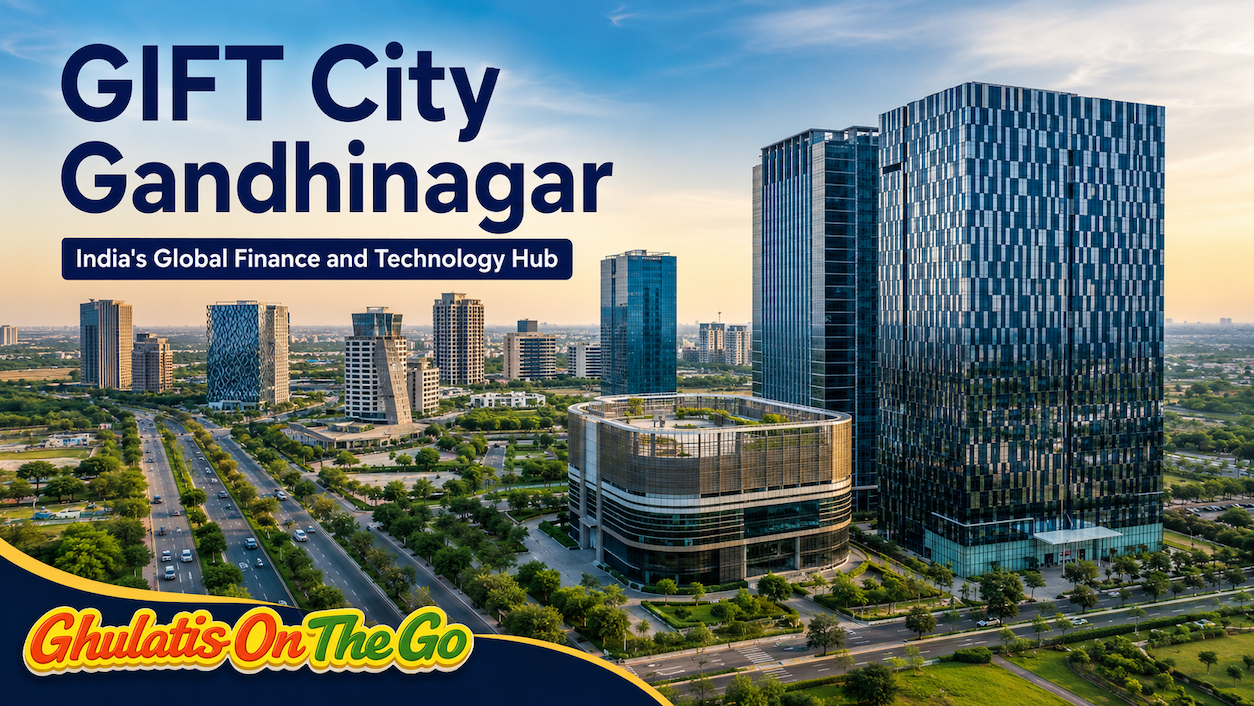
For everyday visitors, GIFT City may appear as a modern skyline with wide roads, glass towers, planned blocks, and new infrastructure. But behind that visible skyline is a much larger institutional experiment. It is a place where urban design, financial regulation, national policy, business incentives, technology infrastructure, and global market ambition come together.
GIFT City is still developing, and its final impact will depend on execution over many years. Its rankings may rise or fall, companies may expand or change strategies, and global finance itself will continue to evolve. What is factual today is that GIFT City has already become India’s first operational smart city, India’s first and only IFSC, the headquarters of IFSCA, a growing base for more than 1000 operational entities, a banking ecosystem with more than 100 billion United States dollars in reported banking asset size as of September 2025, and a recognized name in global financial centre rankings.
The story of GIFT City is therefore not only about Gandhinagar or Gujarat. It is about India’s attempt to build a globally connected financial platform on Indian soil. It is about giving Indian and international businesses a place where finance, technology, infrastructure, and regulation can work together. It is about the belief that a planned city can become more than a physical address. It can become a gateway for capital, innovation, talent, and international confidence.
As GIFT City continues to expand, its importance will be measured not only by buildings completed or companies registered, but by the depth of its markets, the quality of its regulation, the strength of its institutions, the comfort of its residents, and the trust it earns from global investors. If these foundations continue to strengthen, GIFT City Gandhinagar will remain one of the most significant economic projects in modern India and one of the most closely watched financial hubs in Asia.