

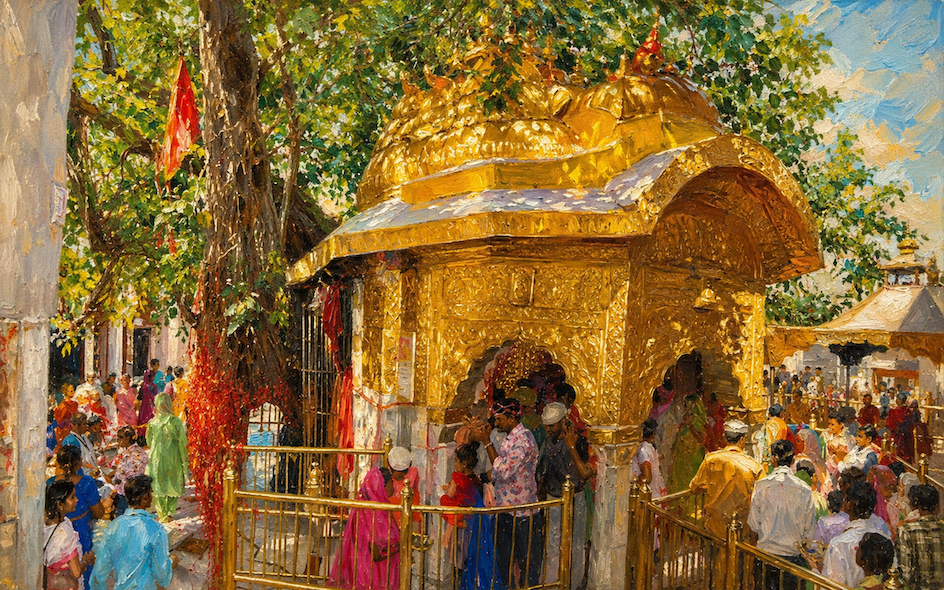
Shri Mata Chintpurni Ji Temple: The Sacred Himachal Shrine Where Devotees Bring Their Worries to Maa
Shri Mata Chintpurni Ji Temple is one of the most important pilgrimage places in Una district of Himachal Pradesh. The official temple website gives the address as Mata Shri Chintpurni Devi Ji, Chintpurni, Tehsil Amb, District Una, Himachal Pradesh, India, pincode 177110. The temple is dedicated to Mata Chintpurni Ji, who is described by the official temple website as a manifestation of the Supreme Goddess Durga and is also called Maa Chinnamasta or Maa Chinnamastika. The word Chintpurni is tied to the faith that the Divine Mother removes chinta, meaning worry, and blesses devotees who come to her with prayer, surrender, and hope.
The shrine is not in Punjab, although many devotees travel there from Punjab and the route from Jalandhar is one of the most common pilgrimage routes mentioned by the official temple site. Chintpurni is in the hill region of Una district, close to the Himachal Pradesh and Punjab border region, and the District Una website describes the fair site as being in village Chintpurni, about 3 kilometers west of Bharwain. The same District Una page records road approach distances of about 56 kilometers from Una, 48 kilometers from Hoshiarpur, and 64 kilometers from Kangra.
The spiritual identity of Shri Mata Chintpurni Ji Temple is closely connected with Maa Bhagwati Chinnamasta. The official temple history page describes it as the old temple of Mata Bhagwati Chinnamasta Devi. According to that temple tradition, after the killing of asuras and victory in a great war, Maa Bhagwati’s companions Jaya and Vijaya still thirsted for blood. The official temple account says that Maa cut her own head and quenched their thirst, and from this form she became known as Maa Chinnamastika or Mata Chinnamasta. The temple website explains the name by saying that Chinna means without and Masta means head.
The same official history page connects the sacred geography of Chintpurni with four Mahadev temples placed in the four directions around the shrine. It names Kaleshwar Mahadev Temple in the east, Narahna Mahadev Temple in the west, Muchhkund Mahadev Temple in the north, and Shiv Bari Temple in the south. The temple source presents this four direction arrangement as part of the reasoning behind declaring the place as Maa Chinnamastika Devi Dham or Mata Chinnamasta Temple.
The story of Pandit Mai Das is central to the living tradition of Chintpurni. The official temple history page says that Pandit Mai Das was a famous devotee of Maa Chinnamasta and worshipped her until she gave him darshan. It also says the place was earlier called Chhabroh, and that after Maa relieved Pandit Mai Das from his tensions, the place became popular by the name Chintpurni.
The District Una version gives a longer local legend. It says that Mai Dass, a Brahmin priest of village Ripoh Muchilian in Tehsil Amb, was traveling to village Pirthipur to visit his parents in law when Chintpurni fell on his way. According to the legend recorded by the district administration, he heard devotional music from the hillock, climbed up, and saw a beautiful girl of about twelve or thirteen years seated with a lion beside her and surrounded by gods singing in praise. The girl disclosed that she was Goddess Durga, said she wished to remain at that site in the form of a pindi, and asked Mai Dass and his progeny to perform puja of the pindi twice a day.
That same District Una account says Mai Dass told the Goddess he was issueless and that the place had no habitation or visible water. The Goddess blessed him with a son and directed him to a place where water would be found under a stone slab. Mai Dass discovered water at the indicated place, brought the slab near the pindi, bathed the pindi, and performed worship as directed. The account continues that after he left the place, he became blind, was brought back by a passerby, apologized to the Goddess, regained his eyesight, constructed a small thatched shelter over the pindi, and became the first inhabitant of the place.
The District Una page also connects the older name of the village to this story. It says the village was recorded as Chhappro because of its association with the chhappar, or thatched shelter, of Mai Dass. Over time, the place came to be known as Chintpurni after the name of the Goddess. This detail is important because it shows how the local story, the village name, and the devotional identity of the shrine are tied together in the district record.
Inside the shrine, the form of the Goddess is a pindi. The Wikipedia article says that the image of Mata Chintpurni is installed in the garbha griha in the form of a pindi, a round stone, and that devotees queue for darshan and make offerings. Since the Wikipedia article itself notes that it needs additional citations, this detail is best read alongside the District Una account, which also describes the deity as a stone idol or pindi placed inside the temple.
The physical description of the temple given by District Una is specific and valuable for anyone trying to understand the shrine beyond a quick travel summary. The district page describes the temple as a single storeyed building made of stones. It says the base is square, a dome forms the center of the roof, and the main entrance faces north. It also records an old banyan tree with a raised platform in front of the entrance, idols of Lord Ganesh and Lord Hanuman in recesses of the facade, and large brass bells hanging inside the entrance.
The same district description says the pindi of the Goddess is placed in a white marble palanquin inside the room. It records that the priests, who are descendants of Mai Dass, sit beside the pindi and perform puja. On the western part of the temple roof, the district page says engraved stone images of Bhairon and Hanuman are placed. It also notes that verandahs and additional rooms have been built to the south and west of the temple for temple trust officials, priests, and devotees during celebrations.
The old banyan trees are part of the temple atmosphere described by official sources. District Una notes one old banyan tree in front of the entrance and another banyan tree in the temple campus where the mundan ceremony of children is performed. This detail matters because many families visit Chintpurni not only for darshan, but also for life rituals connected with children and family vows.
Offerings at Shri Mata Chintpurni Ji Temple have their own traditional identity. District Una records that usual offerings by a devotee consist of seven pieces of supari, a piece of coconut, a red flag, and mauli, which are bound together. The Wikipedia page also lists offerings commonly brought by devotees, including sweets such as suji halwa, laddoo, barfi, kheer, coconut or other fruits, chunni, red colored dhwaja, flowers, and ghee.
A special offering during the fair is also described by District Una. The page says that on the eighth day of the fair, devotees offer karah, halwa, and chattar with eighty four tiny bells hanging on its fringes. District Una records the devotional meaning as representing eighty four lakh births in different forms from which the devotee seeks salvation from the Goddess.
The Chintpurni fair is one of the most important annual features of the shrine. District Una says the Chintpurni fair is locally known as Mata Da Mela, meaning the fair of the Mother Goddess. It is held in village Chintpurni on a spur of the hill range of the same name, near the temple of Goddess Bhagwati Chhinmastaka. The district source records that the fair has been held from time immemorial and takes place three times a year, in Chet, Sawan, and Asanj.
The same District Una page explains the fair calendar in more detail. It says that in Chet and Asanj, the fair is held during Navratras, while in Sawan it takes place during the first ten days of Shukla Paksha, the bright half of the lunar month. It also says the fair is residential in nature, lasts nine days during Navratras and ten days in Sawan, continues day and night, and draws the largest attendance on its eighth day.
The official temple festival page lists the major festival occasions in a simpler format. It names Chaitra Navaratri in March and April with a ten day mela, every month Sakranti, Sawan Ashtami in July and August with a ten day mela, Asuj Navratras in October with a ten day mela, and a New Year event from December 28 to January 2. The difference between the district description and the temple festival list should be kept as source specific wording rather than merged into one unsupported claim.
Daily worship at the temple follows a regular pattern according to the official religious activity page. The page lists Goddess Sanan and Aarti daily at 6:30 AM. It lists Bhog from 12:00 to 12:30 PM and notes that darshan has been stopped during that time. It lists Evening Sanan and Aarti daily from 6:30 PM to 8:00 PM. It also lists Goddess Sayan daily at 10:00 PM. Visitors should still verify timings through the official temple website or temple office before traveling, especially during fairs, Navratras, holidays, and special arrangements.
Havan and mundan are also listed by the official temple site. The Havan and Mundan page states in Hindi that the temple performs havan every morning at 6:00 AM in the havan kund inside the temple premises. It says a pilgrim who wishes to have havan performed can do so after taking permission from the temple officer and obtaining a receipt for 500 rupees, with wood provided for the havan. It also says the devotee must arrange other havan materials and the pandit at their own level. The same page states that devotees may have a child’s mundan performed in the temple premises according to an auspicious muhurat.
The temple is managed through formal administration. District Una records that until 1961 the fair was organized by the District Board of Hoshiarpur, and that by August 1962, Panchayat Samiti Amb took over management of the fair. It further records that since 12 June 1987, the Chintpurni Temple Trust has existed with the Deputy Commissioner of Una and the SDM of Amb serving as Commissioner and Assistant Commissioner respectively, and that a temple office of Tehsildar rank handles temple affairs.
The official temple site lists facilities that make the pilgrimage more manageable for visitors. Its facilities page says the temple trust provides free breakfast, lunch, and dinner in its langar. It also lists government accommodation options such as HPPWD Rest House Bharwain, HPPWD Rest House Amb, HPPWD Rest House Gagret, H P Tourism Hotel Chintpurni Heights at Bharwain, and Temple Chintpurni Yatri Bhawan Bharwain.
Sanitation and basic infrastructure are also listed on the official facilities page. It says toilet facilities have been constructed at five points in the Chintpurni area, including Bharwain parking, Mirgu, Chintpurni, Hospital Road, and two blocks near Shiv Mandir Chintpurni. It says rain shelters have been constructed at eight different points along roads and paths used by pilgrims. It also says street lighting has been provided in the area used by pilgrims, including a five kilometer stretch and a three kilometer Samnoli bypass, with more than six hundred lighting points maintained from temple funds.
The same facilities page lists parking at the new bus stand by HRTC, a water ATM at the old bus stand Chintpurni, hospital facility, forty benches from Mubarikpur to Chintpurni, twenty four drinking water taps in the area, fire tender facilities, and additional toilet facilities. These details are useful for visitors because pilgrimage at Chintpurni can involve walking, queueing, waiting during peak times, and moving through crowded bazaar and temple areas.
For accommodation, Himachal Pradesh Tourism Development Corporation provides useful information about The Chintpurni Heights at Bharwain. HPTDC says the property was formerly known as Yatri Niwas, has been renovated, and is situated about two kilometers from the Chintpurni shrine. It describes the property as a budget class accommodation with airy rooms, attached baths, hot and cold running water, satellite television, restaurant, room service, parking within the premises, and public washroom.
HPTDC also gives travel distances for The Chintpurni Heights area. It lists Chandigarh to Chintpurni as 170 kilometers with an estimated drive of three and a half hours, Pathankot to Chintpurni as 104 kilometers with an estimated drive of two and a half hours, and Dharamshala to Chintpurni as 70 kilometers with an estimated drive of two hours. These estimates are hotel page guidance, so actual travel time can vary by traffic, road work, weather, and festival crowds.
The official temple site gives several road and rail routes. For road travel, it gives the Delhi, Chandigarh, Ropar, Nangal, Una, Mubarakpur, Bharwain, Chintpurni route. It says Delhi and Himachal State Transport run buses on the Delhi, Chandigarh, Chintpurni route, and that direct buses on the Delhi to Dharamshala and Delhi to Palampur routes may stop at Bharwain or Chintpurni. It also says frequent state transport bus services are available from major cities of Punjab, Haryana, and Jammu and Kashmir.
For visitors from Jalandhar, the official temple site specifically mentions the Delhi, Jalandhar, Hoshiarpur, Gagret, Bharwain, Chintpurni route. It says a visitor may take a fast train from Delhi to Jalandhar and then continue by bus or taxi to Chintpurni. It lists Jalandhar to Chintpurni as 90 kilometers and says the journey should take no more than three hours by private transport. This makes the shrine especially relevant for Punjabi families and diaspora visitors who often plan temple visits around Jalandhar, Hoshiarpur, Una, and nearby towns.
For rail access, the official temple site lists the closest railheads as Hoshiarpur at 42 kilometers and Amb Andaura at 19 kilometers, with bus and taxi services available from those towns to Chintpurni. The District Una tourist page says the nearest railway station to Chintpurni Temple is Una Himachal at Una town, about 55 kilometers from Chintpurni. Since both are official or government linked sources but present different railway guidance, the safest wording is that Amb Andaura, Hoshiarpur, and Una Himachal are all relevant rail options depending on route, train availability, and onward road transport.
For air travel, there is also a source difference. The official temple travel page says the nearest airport is Gaggal near Kangra and gives the Gaggal to Chintpurni distance as about 60 kilometers. The District Una tourist page says the nearest airport to Chintpurni Temple is Gaggal at Kangra near Dharamshala and gives the distance as about 70 kilometers from Chintpurni. District Una’s general How to Reach page also notes that Una district has no airport and lists Chandigarh International Airport and Gaggal Airport near Dharamshala as nearby airport options for Una district.
The District Una How to Reach page is helpful for understanding wider access to the region. It says Una district is on the border of Himachal Pradesh and Punjab, is well connected by roads with major cities and towns of Himachal Pradesh and neighboring states, is accessible throughout the year, and is easily visited by road or train. It lists auto rickshaw and taxi as local commuting modes.
The same District Una page lists important bus routes to and from Una. These include Delhi, Panipat, Kurukshetra, Ambala, Chandigarh, Roopnagar, Kiratpur, Nangal; Amritsar, Jalandhar, Ludhiana, Hoshiarpur, Jhalera; Baijnath, Palampur, Dharamshala, Kangra, Ranital, Dehra, Bharwain, Amb; Katra, Jammu, Pathankot, Hoshiarpur, Jhalera; and other routes through Shimla, Chamba, Manali, Hamirpur, and nearby towns. It also states that HRTC operates super luxury, luxury, super fast, and ordinary buses, and that private buses and taxis are available within the state.
Pilgrim conduct is clearly addressed by the official temple website. Its Do’s and Don’ts page instructs visitors to go for Goddess darshan in line after taking a darshan parchi from the temple security guard, donate cash in the donation box or donate in the office and take a receipt, beware of pickpockets and chain snatchers, maintain the line, avoid giving anything to beggars, help maintain sanitation, use dustbins, and keep patience and silence.
The same page lists actions that visitors should avoid. It says not to go for darshan without darshan parchi, not to bribe anyone for back door darshan entry, not to feed monkeys, not to accept polythene, not to litter anywhere, not to smoke and drink, not to touch abandoned items, and not to throw prasad on the floor. These rules are not just formal instructions. They reflect the practical challenges of a busy shrine where crowds, offerings, animals, sanitation, safety, and queue discipline all matter.
During festivals and melas, the temple trust makes special arrangements. The official special arrangements page says extra police force is called for security and discipline, the temple trust administration is divided into nine segments for better management, and additional district magistrate and sub district magistrate officials are the main officers in charge during special days. It also says the temple remains open day and night during such special arrangements.
The special arrangements page also mentions temporary toilets for devotees and visitors, water arrangements where there is no tap, pitchers and water tankers, and extra employees for langar, cleaning, and other work. These details show why visitors should treat Navratri, Sawan Ashtami, Sakranti, and New Year periods differently from ordinary travel days. The pilgrimage experience can be more festive and spiritually powerful, but it can also involve more waiting, more crowd control, and greater need for patience.
The temple’s broader regional setting is also significant. District Una’s history page says Una district was part of Hoshiarpur district of Punjab until 1 November 1966, after which hill areas including Una tehsil were transferred to Himachal Pradesh. It says Una remained a tehsil of Kangra district until 1 September 1972, when Himachal Pradesh reorganized the then Kangra district into Una, Hamirpur, and Kangra districts. This history helps explain why Chintpurni feels closely connected to Punjab routes, Punjabi families, and the Jalandhar and Hoshiarpur travel corridor, even though the shrine is officially in Himachal Pradesh.
Una district also has other places of religious and cultural interest. The District Una Places of Interest page notes Dharamshala Mahanta near the holy abode of Goddess Chintpurni, about 62 kilometers from Una, and says a large number of devotees visiting Goddess Chintpurni also visit Dharamshala Mahanta. It also describes Shiv Bari near Gagret on the Hoshiarpur Dharamshala road, a Shiva temple associated in local belief with Guru Dronacharya and his daughter Jayati.
For visitors who want to understand Chintpurni as part of a larger pilgrimage route, nearby sacred places can matter. The official temple history page itself names Kaleshwar Mahadev, Narahna Mahadev, Muchhkund Mahadev, and Shiv Bari in the four directions around Chintpurni as part of the Chinnamastika Dham tradition. District Una also documents regional religious locations around Una, including Shiv Bari and Dharamshala Mahanta, showing that the temple is part of a wider sacred and cultural landscape rather than an isolated shrine.
Several secondary travel sources describe Chintpurni as a Shakti Peeth. Wikipedia states that Chintpurni is home to Maa Chintpurni Temple and describes it as a major pilgrimage site as one of the Shakta pithas in India. Tour My India also describes Chintpurni Temple as a Shakti Peeth and connects the shrine with Mata Shri Chhinnamastika Devi. Because the Wikipedia article displays a notice asking for additional citations, the most careful approach is to use official temple and District Una records for core facts, and use Wikipedia only as a secondary reference for general context.
The devotional importance of the shrine lies in its promise of relief from worry. The official temple website says human desires lead people toward anxiety and worry, and that the Divine Mother relieves devotees from worries by fulfilling their desires. The website says this is why she is appropriately called Mata Chintpurni. Whether a visitor comes with a family vow, a child’s mundan, a prayer for peace, a difficult decision, or simple gratitude, the emotional center of the pilgrimage is the same. Devotees come to Maa with chinta, and the name Chintpurni expresses the hope that worry will be completed, answered, or lifted.
The shrine is also a place where physical movement becomes part of devotion. A visitor may begin from Jalandhar, Hoshiarpur, Una, Kangra, Chandigarh, Delhi, or another place, travel by road or train, arrive near Bharwain or Chintpurni, move through the bazaar, take darshan parchi, wait in line, hear bells at the entrance, offer prasad, and stand before the pindi of Mata Chintpurni Ji. The official sources do not present the pilgrimage as only a sightseeing stop. They describe rituals, queues, bells, offerings, langar, havan, mundan, fairs, and the responsibilities of visitors.
For families, Chintpurni is especially meaningful because its rituals are intergenerational. The District Una legend says the Goddess instructed Mai Dass that he and his progeny should perform puja of the pindi. The district page also says priests who are descendants of Mai Dass sit beside the pindi and perform puja. The official Havan and Mundan page mentions the option of mundan for children in the temple premises according to auspicious muhurat. Together, these details show the shrine as a place where lineage, children, vows, and family memory are all present.
A visitor planning darshan should pay attention to the practical details. Official sources mention darshan parchi, queue discipline, donation receipts, sanitation, dustbins, not feeding monkeys, not accepting polythene, not touching abandoned items, and not throwing prasad on the floor. These are simple instructions, but they matter at a crowded shrine. They protect the sanctity of the place, help the administration manage devotees, and keep the experience respectful for everyone.
The best time to visit depends on the purpose of the trip. Those who want the energy of a major devotional gathering may prefer Chaitra Navaratri, Sawan Ashtami, Asuj Navratras, monthly Sakranti, or the New Year event listed by the official temple site. Those who prefer a quieter darshan may choose a regular weekday and avoid major mela periods. District Una makes clear that the fair can continue day and night and draw the largest attendance on the eighth day, so travel planning, accommodation, and patience become especially important during those times.
For travelers from Punjab, especially from Jalandhar and Hoshiarpur, Chintpurni is one of the most accessible Himachal shrines. The official temple page lists Jalandhar to Chintpurni as 90 kilometers by the Jalandhar, Hoshiarpur, Gagret, Bharwain, Chintpurni route. It lists Hoshiarpur to Chintpurni as 42 kilometers. District Una says the temple can be approached by metalled road from Hoshiarpur, Una, and Kangra. This makes the shrine a natural devotional destination for families who combine Punjab visits with a Himachal temple journey.
For visitors from Delhi, the official temple website lists road routes through Chandigarh, Ropar, Nangal, Una, Mubarakpur, Bharwain, and Chintpurni. It also mentions bus connections and train based options through Jalandhar, Hoshiarpur, Chandigarh, Una, and other points. District Una confirms that Una is accessible year round and can be visited by road or train. The most accurate route should be selected by checking current transport schedules before departure, because train timings, bus services, and road conditions can change.
A careful travel plan should also consider accommodation. The official temple site lists government accommodation and temple accommodation options, while HPTDC gives details for The Chintpurni Heights at Bharwain, about two kilometers from the shrine. During Navratras, Sawan, Sakranti, and New Year periods, demand can be high. A visitor should avoid assuming that accommodation will be available on arrival during peak fairs.
Chintpurni is more than a temple visit. It is a meeting point of Shakta devotion, local legend, Himachal hill geography, Punjab travel routes, family rituals, temple administration, annual fairs, and living faith. The official temple website presents Mata Chintpurni Ji as the Divine Mother who removes worries. District Una preserves the story of Mai Dass, the pindi, the old chhappar, the temple structure, the bells, the banyan trees, the fair, and the management history. The temple’s own pages document aarti, havan, mundan, langar, facilities, visitor conduct, and special arrangements.
For devotees, the most important fact may be the simplest one. The shrine’s name carries the heart of the pilgrimage. Mata Chintpurni Ji is approached as the Mother who hears worry, receives prayer, and gives strength. Some visitors come after a wish is fulfilled. Some come before an important life event. Some come for a child’s mundan. Some come during Navratri or Sawan. Some come quietly, without any public reason, carrying only a private prayer. The tradition of the temple gives all of them a place to stand, wait, bow, and remember that worry does not have to be carried alone.