

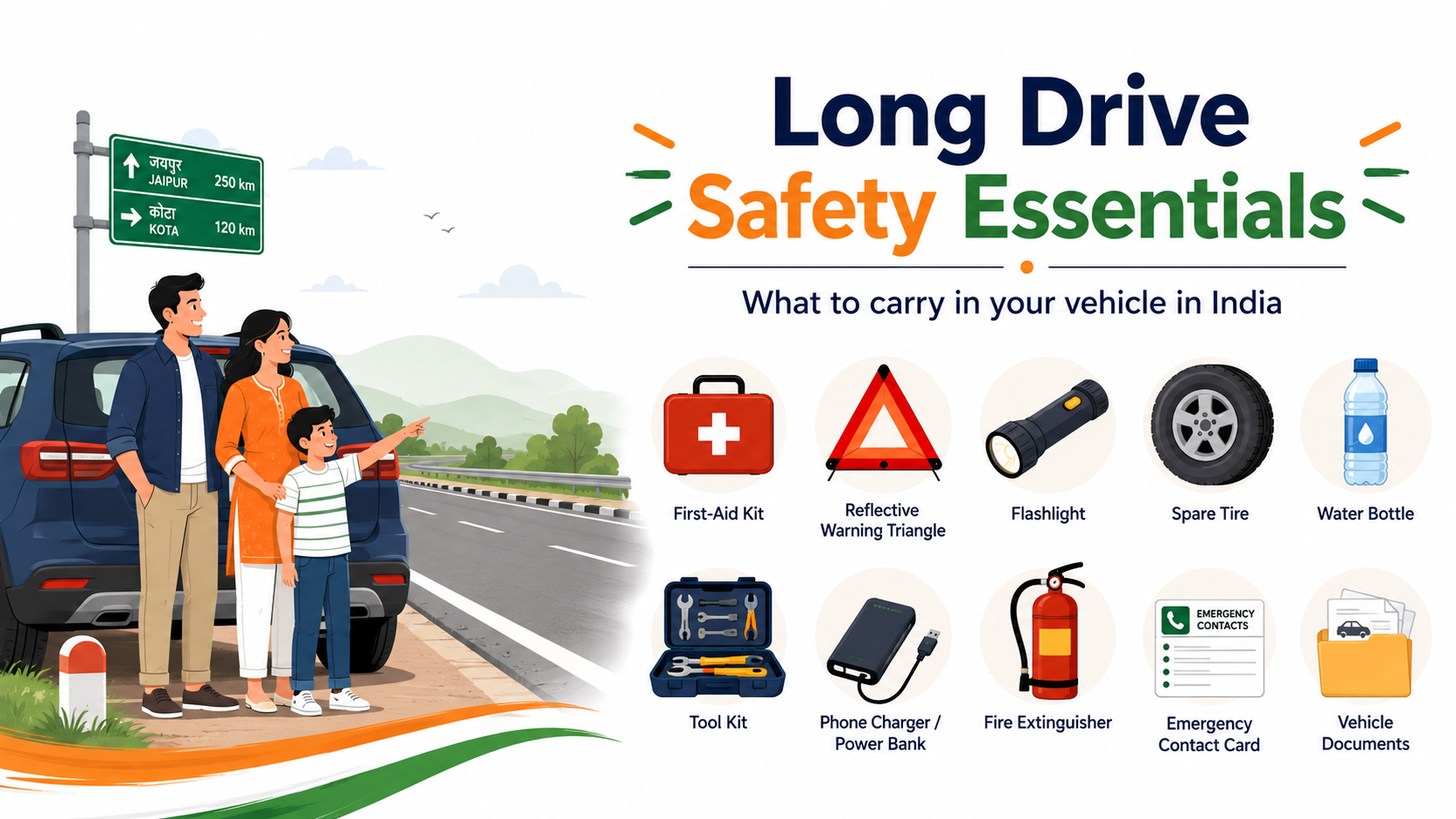
A long road trip in India can be one of the best ways to experience the country. From highways and expressways to hill roads, rural routes, coastal drives, city traffic, and remote stretches, every journey has its own charm. But long vehicle travel also requires preparation. Safety should not begin after something goes wrong. It should begin before the vehicle leaves home.
The importance of preparation is backed by road safety data. According to the Ministry of Road Transport and Highways’ Road Accidents in India 2023 report, India recorded 4,80,583 road accidents in 2023, resulting in 1,72,890 deaths and 4,62,825 injuries. The same report states that these figures translate to an average of 1,317 accidents and 474 deaths every day.
That is why every long-distance traveler should think beyond fuel, food, and hotel bookings. A safe vehicle should carry items that help with medical emergencies, breakdowns, visibility, communication, documentation, hydration, and passenger protection. These items do not guarantee that every problem can be avoided, but they can improve your ability to respond calmly and quickly.
One of the most important items to carry is a proper first-aid kit. In India, the Central Motor Vehicles Rules specify first-aid kit contents such as antiseptic cream, sterilized dressings, sterilized elastic plaster, waterproof plaster, gauze, and elastic bandage for wounds and burns. A 2024 amendment also added Feracrylum 1% gel to the first-aid kit requirement.
A practical vehicle first-aid kit should also include adhesive bandages, antiseptic wipes, disposable gloves, hand sanitizer, medical tape, tweezers, saline solution, basic pain relief medicine, motion sickness medicine, and any doctor-prescribed medicines needed by passengers. The American Red Cross recommends keeping a first-aid kit in the vehicle because supplies may not be readily available while traveling, especially in less populated areas.
The second essential category is emergency contact information. Every vehicle should carry a small printed card with important phone numbers. In India, 112 is the pan-India emergency response number for police, fire, rescue, health, and other emergency services. The 112 system also supports smartphone panic activation and the 112 India mobile app.
For travel on National Highways, keep 1033 saved and written down. The National Highway Helpline provides 24x7 assistance on NHAI tolled stretches for emergency and non-emergency issues. It can help arrange ambulances, highway patrol vehicles, and cranes when required.
A good emergency card should include 112, 1033, family contacts, insurance helpline, roadside assistance number, hotel contact, and the contact number of the vehicle owner. Keep one copy in the glove box and one in a visible travel folder.
The third essential item is a reflective warning triangle. If your vehicle breaks down on a highway, curve, flyover, bridge, or poorly lit road, visibility becomes a safety issue. A reflective triangle warns other drivers that a stopped vehicle is ahead. It is especially useful at night, during rain, fog, or low-visibility conditions. A high-visibility vest is also a smart addition because it helps other drivers see you if you must step outside the vehicle.
A flashlight or rechargeable torch is another must-have. Mobile phone flashlights are useful, but they drain battery quickly and are not ideal for inspecting tyres, checking under the bonnet, or standing near a stopped vehicle at night. Keep a separate flashlight with extra batteries or a rechargeable unit. A small headlamp is even better because it keeps both hands free.
Every long-trip vehicle should also carry a spare tyre in usable condition, jack, wheel spanner, puncture repair kit, and portable tyre inflator. A spare tyre is only useful if it has proper air pressure and the driver knows where the jack points are located. Before leaving, check the spare tyre, not just the four tyres already on the vehicle.
A portable tyre inflator can be extremely useful on Indian highways, where the next fuel station or repair shop may be far away. It can help you safely reach a repair point after a slow puncture. A tubeless puncture repair kit can also help in minor cases, but it should be used carefully and only when the damage is suitable for temporary repair.
A basic tool kit should include screwdrivers, pliers, adjustable wrench, gloves, duct tape, cable ties, spare fuses, and a tyre pressure gauge. These items may not fix every problem, but they can help with loose parts, minor electrical issues, number plate problems, luggage rack issues, or temporary roadside fixes.
A jump starter or jumper cables are also worth carrying. A weak battery can leave a vehicle stranded, especially after long stops, repeated short drives, cold weather in hill areas, or accidental use of lights while parked. A compact jump starter is convenient because it does not require another vehicle, but it must be charged before the trip.
A small fire extinguisher is strongly recommended. Vehicle fires can begin from electrical faults, overheating, fuel leaks, or accidents. Keep the extinguisher reachable, not buried under luggage. For commercial, tourist, school, or transport vehicles, fire extinguisher rules may be more specific, so vehicle owners should check the applicable category rules before travel.
Carry drinking water and oral rehydration salts. India’s long-distance routes can involve heat, delays, traffic jams, tyre issues, and unexpected road closures. Water is not only for drinking; it can help with hand washing, minor cleaning, and cooling passengers. Oral rehydration salts can help during dehydration, especially in hot conditions.
Carry non-perishable snacks such as dry fruits, biscuits, energy bars, or sealed food packets. This is not only about comfort. If a breakdown, roadblock, landslide, protest, accident diversion, or traffic jam delays your journey, food and water can become safety essentials.
Documents are also part of safety preparation. Before a long drive, make sure you have access to your driving licence, registration certificate, insurance, PUC certificate, and any permit or fitness documents that apply to your vehicle category. The Ministry of Road Transport and Highways has stated that transport-related documents available through DigiLocker or mParivahan are legally recognized at par with original documents, while documents not available on those platforms may not be treated the same way.
A charged phone, car charger, and power bank are essential. Navigation, emergency calling, payment, hotel booking, FASTag support, roadside assistance, and family communication all depend on battery power. A charging cable for every passenger’s phone type is useful. Download offline maps before long rural or mountain routes because mobile signal may not always be reliable.
For family travel, passenger safety items matter. If children are traveling, use the correct child restraint system or seat belt arrangement for the child’s age, size, and vehicle type. In a Lok Sabha answer, the Ministry of Road Transport and Highways stated that Section 194B provides punishment when a motor vehicle is driven with a child under 14 who is not secured by a safety belt or child restraint system. It also stated that certain M1 vehicles must have provision for installing child restraint systems and that drivers of applicable M1 vehicles must ensure children up to 12 are seated in an appropriate child restraint system.
Carry seat belt cutters and a window breaker tool in an accessible place. These tools are designed for emergency escape situations. They should not be treated as toys and should be kept away from children, but accessible to adults.
Another useful item is a small emergency blanket or shawl. It can help during cold weather, shock after an accident, unexpected overnight delays, or travel through hill areas. In hot regions, a light cotton sheet or towel can help protect passengers from sun exposure while waiting outside the vehicle.
For monsoon and winter travel, carry rain protection and visibility items. A compact umbrella, raincoat, microfiber cloth, spare wiper fluid, and anti-fog cloth can help during wet driving conditions. Good visibility is a safety issue, not just a comfort issue.
It is also smart to carry cash in small denominations. Digital payments are common, but remote areas, network failures, toll diversions, small repair shops, parking lots, and roadside vendors may still require cash. Keep the cash safely divided, not all in one place.
For long drives, carry a printed route plan with major stops, fuel stations, hospitals, and overnight halt points. Mobile navigation is helpful, but printed backup information can help when phone batteries die or network coverage fails.
Finally, every traveler should know what to do if they witness or reach a road accident. India’s Good Samaritan guidelines protect people who help road accident victims. The guidelines state that a bystander or Good Samaritan may take an injured person to the nearest hospital, should be allowed to leave immediately, and should not be liable for civil or criminal liability.
A safe road trip is not just about reaching the destination. It is about being ready for the unexpected. A well-prepared vehicle should carry a first-aid kit, emergency numbers, reflective warning triangle, flashlight, tyre tools, spare tyre, inflator, documents, water, food, chargers, fire extinguisher, child safety equipment when needed, and basic repair supplies.
Before leaving for a long drive in India, take a few extra minutes to check your vehicle and pack your safety essentials. That small effort can make the journey safer for you, your family, your passengers, and others on the road.