

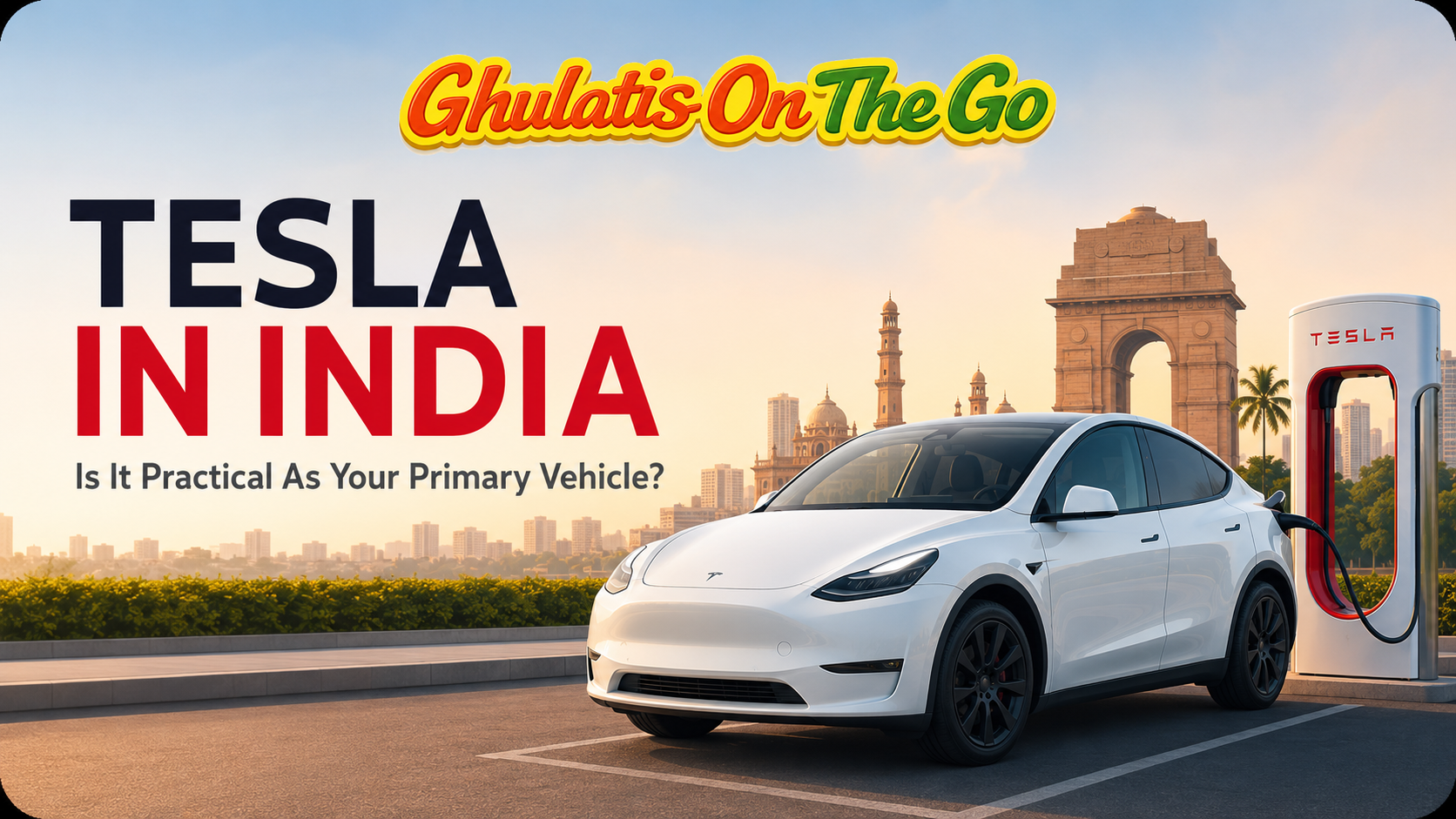
Tesla has always had a special pull in India. For years, the brand lived more in conversations, YouTube reviews, and overseas travel stories than on Indian roads. That has now changed. Tesla has entered India, opened experience locations, listed official Supercharger sites, and started selling the Model Y family. That makes the question more practical than ever. Should someone in India buy a Tesla and use it as the primary vehicle?
The answer depends on how the vehicle will be used. The proven data supports a clear conclusion. A Tesla can work as a primary car in India for a specific type of buyer. It is best suited for people who live in or near a major city where Tesla has a presence, can charge at home or at a reliable private parking location, drive predictable daily routes, and treat the car as a premium electric SUV rather than a low cost family runabout. It is not yet the best primary vehicle for every Indian household, especially for buyers who rely entirely on public charging, travel frequently through areas with uncertain charging access, or live far from Tesla service coverage.
The most important point is that Tesla in India is still at an early stage. The cars are available, the brand is active, and the charging network exists in selected places. But the support ecosystem is not as mature as it is in markets where Tesla has been selling cars for many years. Anyone buying a Tesla in India should think beyond the badge and look carefully at charging, service access, purchase price, range, warranty, and local driving conditions.
What Tesla Models Are Available In India
As of June 2026, the proven public data shows that Tesla India is focused on the Model Y family. The current India lineup consists of the Model Y Premium RWD and the Model Y L Premium AWD.
The Model Y Premium RWD is the five seat version. Tesla India lists it with a WLTP range of 500 km, rear wheel drive, standard range battery, zero to one hundred km per hour acceleration in 5.9 seconds, seating for up to five adults, 2,138 litres of cargo capacity, 167 mm ground clearance, a 16 inch centre touchscreen, and an 8 inch rear touchscreen. Its Tesla listed Supercharging maximum is 175 kW, and Tesla says it can add up to 238 km of range in 15 minutes under stated conditions.
The Model Y L Premium AWD is the larger six seat version. Tesla India lists it with a WLTP range of 681 km, long range battery, dual motor all wheel drive, zero to one hundred km per hour acceleration in 5.0 seconds, seating for up to six adults, 2,539 litres of cargo capacity, 169 mm ground clearance, a 16 inch centre touchscreen, and an 8 inch second row touchscreen. Its Tesla listed Supercharging maximum is 250 kW, and Tesla says it can add up to 288 km of range in 15 minutes under stated conditions.
Autocar India reported in May 2026 that Tesla had revised the Indian Model Y lineup, pricing the Model Y Premium RWD at Rs 50.89 lakh and the Model Y L Premium AWD at Rs 61.99 lakh, both ex showroom. The same report stated that Tesla had discontinued the earlier Model Y Long Range Premium RWD variant in India. That means the practical buying choice is between the five seat rear wheel drive Model Y and the six seat all wheel drive Model Y L.
Are Teslas In India Different From Teslas Elsewhere
Yes, in several important ways.
The biggest difference is the lineup. In some global markets, Tesla has offered several model families, including Model 3, Model Y, Model S, Model X, and Cybertruck. In India, the available official consumer lineup is centered on the Model Y family. That makes India a much narrower Tesla market than mature Tesla markets.
The second difference is price. Reuters reported that Tesla entered India with imported Model Y vehicles and that India import tariffs pushed pricing much higher than in major overseas markets. Reuters also reported that the Model Y sold in India is imported rather than built locally. This matters because India pricing is not simply the global Tesla price converted into rupees. Duties, levies, logistics, and local market positioning all affect the final cost.
The third difference is the Model Y L. India gets the longer six seat Model Y L Premium AWD, which is aimed at buyers who want more space and a more family oriented configuration. Its six seat layout and 681 km WLTP range make it more appealing for Indian families who want a premium electric SUV with more cabin flexibility.
The fourth difference is charging context. A Tesla buyer in the United States, parts of Europe, or China may have access to a very large Tesla Supercharger network. In India, Tesla Superchargers exist, but the official Tesla list is still concentrated in selected locations. That changes how convenient the car feels as a primary vehicle.
The fifth difference is software and driver assistance context. Tesla India includes language around Full Self Driving Capability, but Tesla itself says the driver must remain attentive and that the vehicle is not autonomous. Indian buyers should not purchase a Tesla on the assumption that it will drive itself. Driver assistance is not the same as driverless driving, and local regulatory approval matters.
Charging A Tesla In India
Charging is the heart of the Tesla ownership question in India. The car itself has enough listed range for most city and intercity use on paper. The bigger question is whether the owner can charge reliably in daily life.
Tesla India lists official Supercharger locations in Gurugram, New Delhi, Mumbai, and Navi Mumbai. These include DLF One Horizon Centre in Gurugram, Orchid Business Park in Gurugram, Worldmark 3 in New Delhi, One BKC in Mumbai, and Nexus Seawoods in Navi Mumbai. These locations are valuable, but they are not yet a nationwide Tesla charging web.
India also has broader public EV charging infrastructure. Government of India data confirms that public charging has expanded. One government release reported 29,151 electric vehicle charging stations across India as of December 2025, including 8,805 fast charging stations and 20,346 slow charging stations. A later government release based on Oil Marketing Company data listed 27,737 installed EV public charging stations and 22,753 operational stations as of March 1, 2026. The numbers come from different reporting scopes, so they should not be treated as identical measures, but they prove that India has a growing public charging base.
Still, the existence of chargers does not automatically make every route easy. A Tesla owner needs chargers that are available, working, compatible, safe, and placed where the driver actually needs to stop. Charging speed also depends on charger type, battery state of charge, battery temperature, weather, vehicle configuration, speed, and elevation. Tesla itself notes that actual driving range and charging performance can vary.
For daily use, home charging is the strongest foundation. If the owner has a dedicated parking spot with electrical access and can install a suitable charger, the Tesla becomes much easier to live with. The car can begin most mornings with enough battery for the day. That reduces dependence on public chargers and turns charging into a routine rather than a search.
Without home charging, ownership becomes more complicated. A buyer who parks on the street, moves between temporary parking spaces, or depends on public chargers for every week of driving must treat charging access as a core purchase condition. In that situation, the car may still work, but it requires more planning than a petrol or diesel vehicle.
Is A Tesla Practical As A Primary Vehicle In India
For some buyers, yes.
A Tesla can be practical as a primary vehicle in India when the owner has reliable home or private charging, lives in a city with Tesla presence or nearby service access, drives mostly predictable routes, and uses the car for urban and planned intercity travel. In this use case, the Model Y Premium RWD offers enough listed range for daily commuting, family errands, airport runs, and many weekend trips. The Model Y L adds more cabin space and more listed range, which can help families who want six seats and better long distance flexibility.
For other buyers, not yet.
A Tesla is less practical as the only vehicle when the owner cannot charge at home, lives far from Tesla service support, regularly drives through rural or remote routes, or needs a car that can be refueled anywhere within minutes. India has many EV chargers, but public charging reliability and availability can vary by city, route, operator, and time. A Tesla buyer should map real charging stops before purchase, not after delivery.
A Tesla also makes less sense for buyers who are stretching their budget. Even after the revised India pricing, the Model Y remains a premium vehicle. Reuters has reported that Tesla pricing in India is high due to import tariffs, and most Indian car buyers purchase far below this price level. Running costs may be lower than petrol, but the upfront cost is high. Lower charging and maintenance costs do not erase the initial purchase price for every buyer.
The best way to judge practicality is to ask four questions.
Can the car be charged overnight at home or at a dependable private location?
Is there a Tesla service centre within a reasonable distance?
Are the owner’s regular highway routes covered by reliable fast charging?
Is the buyer comfortable paying a premium price for an imported electric SUV?
If the answer to all four questions is yes, a Tesla can be a practical primary car. If one or more answers are no, the buyer should pause and compare alternatives.
Reliability Of Tesla
Tesla reliability needs a careful answer because the data is mixed and India specific long ownership data is limited.
Tesla India provides a clear warranty structure. The Basic Vehicle Limited Warranty covers 4 years or 80,000 km. The battery and drive unit warranty is 8 years or 160,000 km for the Model Y Premium RWD and 8 years or 192,000 km for the Model Y L, with minimum 70 percent battery capacity retention during the warranty period. This is strong coverage on the expensive battery and drive unit components.
Independent reliability data from outside India is not perfectly consistent. JD Power lists the 2025 Tesla Model Y with an average quality and reliability score of 78 out of 100, while also showing a strong driving experience score. What Car in the United Kingdom rated Tesla seventh among brands in its reliability survey, with a 94.5 percent brand reliability rating and a 97.1 percent score for the Model Y. On the other hand, Germany focused TÜV Report coverage for 2026 reported that the Model Y had a high defect rate in the two to three year vehicle category, with issues linked to areas such as suspension, brakes, and lighting.
These results do not all measure the same thing. JD Power relies on verified owner feedback and rating methodology. What Car is a survey of owner reported reliability. TÜV data is based on vehicle inspection outcomes in Germany. They are useful, but they are not India specific. India now has Tesla sales, but the vehicle population is still young, and there is not yet a large public record of long term Indian Model Y reliability.
The fair conclusion is this. Tesla has strong battery and drive unit warranty coverage, strong software and electric powertrain strengths, and good owner satisfaction in some studies. It also has mixed independent reliability signals in some markets, especially around defects that are not the battery or motor. Indian buyers should not assume perfect reliability just because the vehicle is electric. They should also not assume poor reliability without evidence. The most honest position is that local long term data is still developing.
Service And Support In India
Service access is another major factor. Tesla lists service centres in Gurugram and Mumbai. Tesla also lists India stores or experience centres in Gurugram, New Delhi, Mumbai, and Bengaluru. This is a meaningful start, but it is still limited compared with brands that have dense dealer and service networks across India.
For owners in Mumbai, Delhi NCR, Gurugram, and Bengaluru, Tesla access is more realistic. For owners in cities far from these centres, service planning becomes a bigger concern. Even if many Tesla issues can be handled through software or mobile diagnosis, physical repairs, body work, tyre issues, suspension concerns, glass damage, or accident repairs may still require location based support.
This is especially important for a primary vehicle. A secondary lifestyle car can tolerate occasional service inconvenience. A primary family car needs predictable uptime. Before buying, a buyer should check the distance to the nearest Tesla service centre, appointment availability, roadside support process, insurance repair network, and parts availability.
The Cost Question
A Tesla in India should not be evaluated only as an electric car. It should be evaluated as a premium imported electric SUV.
Tesla India pricing places the Model Y far above the price of most vehicles sold in India. Running costs can be attractive, especially with home charging. Reuters reported that Tesla India leadership said buyers could recover a meaningful portion of the purchase price through fuel and maintenance savings over four to five years, with home charging costing much less than petrol. That is useful, but it is still a company claim and depends on usage, electricity rate, petrol price, distance driven, insurance, tyre replacement, financing cost, resale value, and service costs.
The economics improve for someone who drives a lot, charges mostly at home, and plans to keep the car for several years. The economics weaken for someone who drives very little, takes a large loan at a high rate, depends on paid fast charging, or changes cars frequently.
In simple terms, the Tesla is not a budget saving shortcut in India. It is a premium car that may offer lower running costs after purchase.
Driving In Indian Conditions
The Model Y has strengths that suit India. Instant torque is useful in city traffic. One pedal style driving can reduce brake use and make stop and go driving smoother. The hatch style rear opening and large cargo volume are practical for family use. The high seating position and quiet cabin add to comfort. The Model Y L adds extra seating flexibility, which can matter for Indian families.
There are also concerns. Ground clearance is listed at 167 mm for the Model Y Premium RWD and 169 mm for the Model Y L. That may be acceptable for many urban roads, but buyers should consider local speed breakers, steep basement ramps, monsoon waterlogging, rough rural roads, and construction zones. Wheel and tyre damage can also be expensive on premium EVs. Since the battery sits low in the vehicle, buyers should be careful about severe underbody impacts.
The touchscreen based control layout is another consideration. Tesla interiors are minimal and software centered. Some buyers love that. Others may prefer physical buttons for climate, mirrors, and common controls. A test drive is important, not optional.
Should You Buy A Tesla In India
Buy a Tesla in India if you want a premium electric SUV, can charge at home, live near Tesla support, accept the high upfront cost, and understand that the Indian Tesla ecosystem is still young. In this situation, the Model Y Premium RWD can be a strong daily vehicle, and the Model Y L Premium AWD can be the better choice for families needing six seats and more listed range.
Do not buy a Tesla in India if you need the simplest possible primary vehicle with support everywhere, cannot charge at home, travel frequently through charging poor routes, or expect self driving autonomy. Also avoid buying one only because of brand hype. The Tesla ownership experience is strongest when charging and service access are solved before purchase.
Final Verdict
Purchasing a Tesla for use in India can be a good idea, but only for the right buyer. The Model Y family offers strong range figures, fast charging capability, modern safety technology, premium performance, and a clear battery warranty. India also has a growing public charging base and Tesla has started building its own charging and service footprint.
At the same time, the practical limits are real. Tesla India currently offers a narrow lineup. The cars are expensive because they are imported. Tesla Superchargers are available in selected metro locations, not nationwide. Service coverage is still concentrated. India specific long term reliability data is still limited because the brand is new in the market.
So the most proven conclusion is this. A Tesla can serve as a primary vehicle in India for a metro based buyer with reliable home charging and access to Tesla service. It is not yet the most practical primary vehicle for every Indian driver. For many buyers, the car will be excellent. For others, the charging and service ecosystem needs to grow further before the decision becomes easy.