

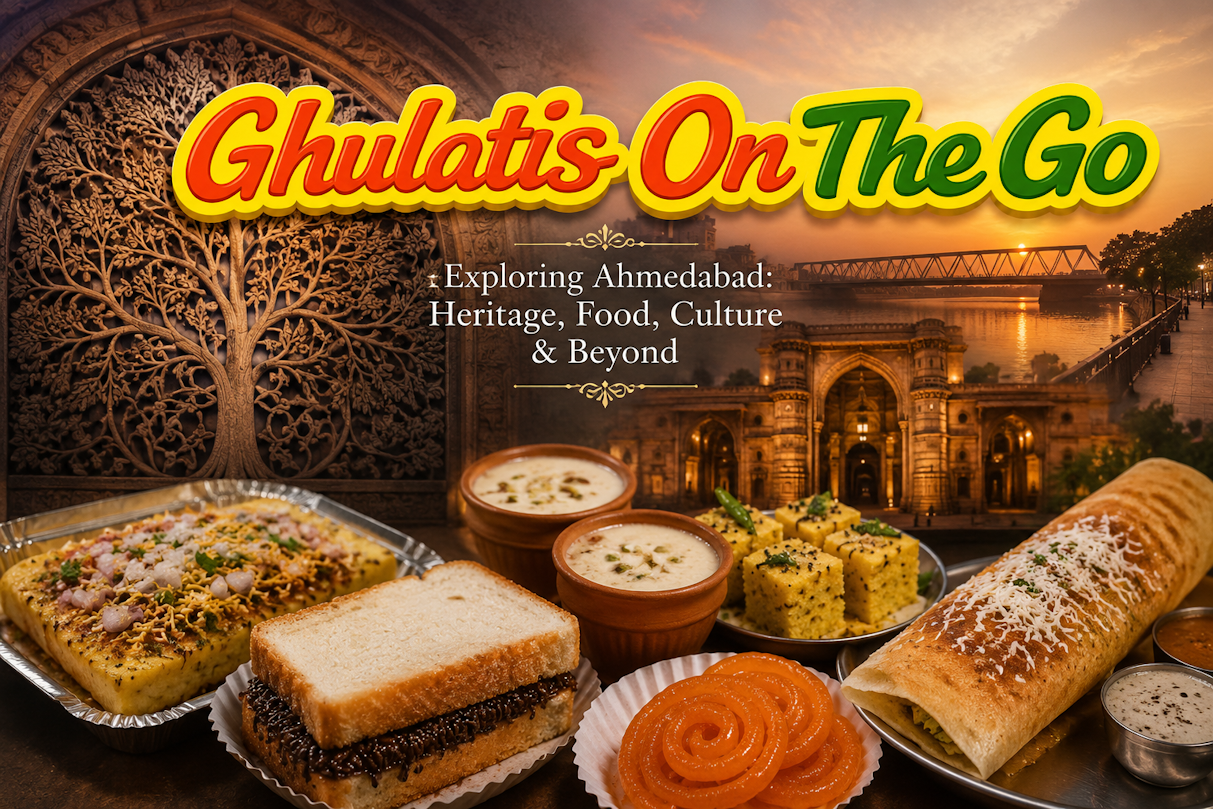
Ahmedabad, or “Amdavad” as locals lovingly call it, is one of India’s most fascinating cities. Sitting along the Sabarmati River in the western state of Gujarat, the city blends old world charm with modern energy in a way that feels completely natural. Ancient mosques stand beside busy shopping streets. Wooden mansions hide inside maze like neighborhoods. Street food vendors work late into the night while new cafés and riverfront promenades attract the younger crowd. Ahmedabad feels alive at every hour of the day.
Founded in 1411 by Sultan Ahmed Shah, the city quickly became an important center for trade, textiles, architecture, and culture. Before Ahmedabad came into existence, the region was known as Ashaval and later Karnavati under Hindu rulers. Sultan Ahmed Shah saw the strategic value of the location and established what would become one of western India’s great cities. During the Gujarat Sultanate and later the Mughal era, Ahmedabad grew into a wealthy trading hub known for its textiles and craftsmanship. Under British rule, it became such an important textile center that it earned the nickname “The Manchester of India.”
Ahmedabad also played an important role in India’s independence movement. Mahatma Gandhi established the famous Sabarmati Ashram here in 1917, turning the city into a center for political thought and peaceful resistance. Even today, Gandhi’s influence can still be felt throughout the city.
Modern Ahmedabad is one of India’s fastest growing urban centers. The population now exceeds eight million in the larger metropolitan region, and the city continues to expand with modern infrastructure, universities, businesses, and technology hubs. Gujarati is the main language spoken here, though Hindi and English are widely understood. Ahmedabad has a strong entrepreneurial spirit, and many families have been involved in business and trade for generations. The city is home to industries ranging from textiles and manufacturing to pharmaceuticals and startups.
Ahmedabad also serves as an excellent base for exploring other parts of Gujarat. Gandhinagar, the state capital located nearby, is known for its clean layout, broad roads, and the beautiful Akshardham Temple. Vadodara offers royal palaces, museums, and cultural landmarks. Anand is famous as the home of Amul and India’s dairy revolution, while Rajkot is known for traditional Kathiawadi cuisine and handicrafts. Bhavnagar attracts visitors heading toward the sacred Jain temples of Palitana.
One of the things that makes Ahmedabad truly special is its heritage. In 2017, the city became India’s first UNESCO World Heritage City, and it is easy to understand why. The old city is filled with history, hidden architectural gems, and living traditions that continue to survive in everyday life.
Perhaps the most fascinating part of old Ahmedabad is its famous Pol neighborhoods. These traditional housing clusters were designed centuries ago as tightly connected communities where families could live together safely and comfortably. Walking through the Pols feels like entering another world. Narrow winding lanes twist through neighborhoods lined with beautifully carved wooden Havelis, hidden courtyards, tiny shrines, and old community spaces. The homes are built close together to create shade and natural cooling during Gujarat’s intense summers.
One of the most charming sights in the Pols is the Chabutra, a decorative bird feeding tower built as a symbol of kindness and community care. Many of these towers still stand today, surrounded by pigeons and daily neighborhood life. The old city does not feel like a museum. People still live here, children still play in the narrow lanes, and local traditions continue naturally as they have for generations.
A wonderful way to experience the old city is through the famous “Mandir to Masjid” Heritage Walk. This early morning walk begins at the beautiful Kalupur Swaminarayan Temple and slowly winds through the old neighborhoods before ending at the grand Jama Masjid. Along the way, visitors pass Jain temples, traditional homes, hidden courtyards, artisan workshops, and historic gateways. The walk beautifully showcases the way Hindu, Jain, and Islamic cultures have shaped Ahmedabad together over centuries.
Ahmedabad is also home to some truly extraordinary architecture. One of the city’s most iconic landmarks is the Sidi Saiyyed Mosque, built in 1573. The mosque is famous for its stunning stone lattice windows, especially the legendary “Tree of Life” carving. The level of detail in the stonework is breathtaking. The intertwined branches and delicate patterns carved from a single slab of stone have become a symbol of Ahmedabad itself.
Just outside the city lies another architectural masterpiece, the Adalaj Stepwell. Built in 1498, this five story structure is one of the most beautiful stepwells in India. Visitors descend through intricately carved pillars, geometric stone patterns, and cool underground chambers that once provided relief from the region’s intense heat. The deeper you go into the stepwell, the cooler and quieter it becomes. The combination of art, engineering, and atmosphere makes it unforgettable.
Food is another reason people fall in love with Ahmedabad. The city is often considered the food capital of Gujarat, and eating here is an experience in itself. One place that absolutely captures the spirit of Ahmedabad is Manek Chowk. During the day, the area functions as a jewelry market. At night, however, it transforms into one of India’s most exciting street food destinations.
The atmosphere at Manek Chowk after dark is pure chaos in the best possible way. Crowds gather around giant cooking stations while vendors prepare buttery dosas, sizzling sandwiches, pav bhaji, kulfi desserts, and countless other snacks. Some of the market’s most famous dishes include the rich and wildly buttery Gotala Dosa and the unusual but famous Cadbury Chocolate Sandwich. The market stays active until nearly three in the morning, and the energy never seems to slow down.
Ahmedabad is also famous for the traditional Gujarati thali experience. Restaurants like Agashiye and Gordhan Thal serve enormous unlimited meals featuring dozens of small dishes. A Gujarati thali includes vegetables, lentils, breads, farsan snacks, sweets, rice, chutneys, buttermilk, and much more. The balance of sweet, savory, tangy, and spicy flavors is what makes Gujarati cuisine unique. The hospitality is just as memorable as the food itself, with servers constantly encouraging guests to eat more.
Street food lovers will also find plenty to enjoy throughout the city. Fafda Jalebi remains one of Ahmedabad’s most beloved breakfast combinations, especially during festivals and weekends. Soft Khaman and Dhokla are found everywhere, while Raipur Bhajiya is famous for spicy fried snacks that locals have loved for decades.
While Ahmedabad deeply values its heritage, the city has also embraced modern urban development. The Sabarmati Riverfront project completely transformed the riverbanks into one of India’s most impressive public spaces. Today, the riverfront is filled with walking paths, cycling tracks, gardens, boating areas, and gathering spaces where locals come every evening to relax and socialize.
One of the newest attractions along the riverfront is the Atal Foot Over Bridge. The bridge has quickly become one of Ahmedabad’s modern landmarks thanks to its striking design and beautiful nighttime lighting. The riverfront area feels especially lively in the evenings when families, joggers, cyclists, photographers, and food vendors all gather together.
Ahmedabad’s younger generation has also helped create a growing café and creative culture. Areas like CG Road, Prahlad Nagar, Satellite, and Navrangpura are filled with modern cafés, rooftop dining spots, co working spaces, and art studios. Educational institutions like IIM Ahmedabad, CEPT University, and the National Institute of Design contribute heavily to the city’s creative and intellectual energy.
Families visiting Ahmedabad often enjoy Gujarat Science City as well. The attraction features robotics exhibits, science galleries, aquariums, interactive displays, and educational experiences that make it especially popular with children.
Despite all of its modernization, Ahmedabad still maintains a deep spiritual side. Sabarmati Ashram remains one of the city’s most peaceful places. Gandhi’s simple residence, historical archives, spinning wheel exhibits, and quiet riverfront setting create an atmosphere of reflection and calm. Many visitors leave the ashram feeling deeply moved by its simplicity.
One of the most exciting times to visit Ahmedabad is during Uttarayan, the famous International Kite Festival held every January. During the festival, rooftops across the city fill with families flying colorful kites while music and celebrations continue all day long. The sky becomes completely covered with kites as people compete to cut each other’s strings using specially prepared thread. Traditional foods like Undhiyu and Jalebi are enjoyed throughout the celebrations, and the city feels full of joy and excitement.
Ahmedabad offers accommodations for every kind of traveler. Luxury visitors often stay at places like The House of MG, ITC Narmada, or Hyatt Regency Ahmedabad. Travelers looking for heritage experiences may enjoy boutique properties such as French Haveli near the old city. Staying close to the heritage areas allows visitors to experience the city’s atmosphere much more intimately.
For anyone planning a trip, the best time to visit Ahmedabad is between October and March when the weather is far more comfortable for walking and sightseeing. Summers in Gujarat can become extremely hot, especially between April and June when temperatures regularly climb above 40°C. Visitors should also remember that Gujarat is officially a dry state, meaning alcohol is restricted and generally requires a permit for tourists.
Getting around Ahmedabad is relatively easy thanks to ride sharing apps, metro expansion, and the city’s large network of auto rickshaws. Traffic can become intense during busy hours, but locals are generally helpful and welcoming toward visitors.
Ahmedabad leaves a lasting impression because it feels deeply authentic. It is not a city trying to impress people with luxury or glamour. Instead, it quietly pulls visitors into its history, its flavors, its traditions, and its everyday life. Whether you are wandering through the hidden Pol neighborhoods, admiring the intricate carvings of the Sidi Saiyyed Mosque, eating late night street food at Manek Chowk, or watching colorful kites dance across the sky during Uttarayan, Ahmedabad feels less like a tourist destination and more like a city with a soul.